The Workarounds Became the Workflow
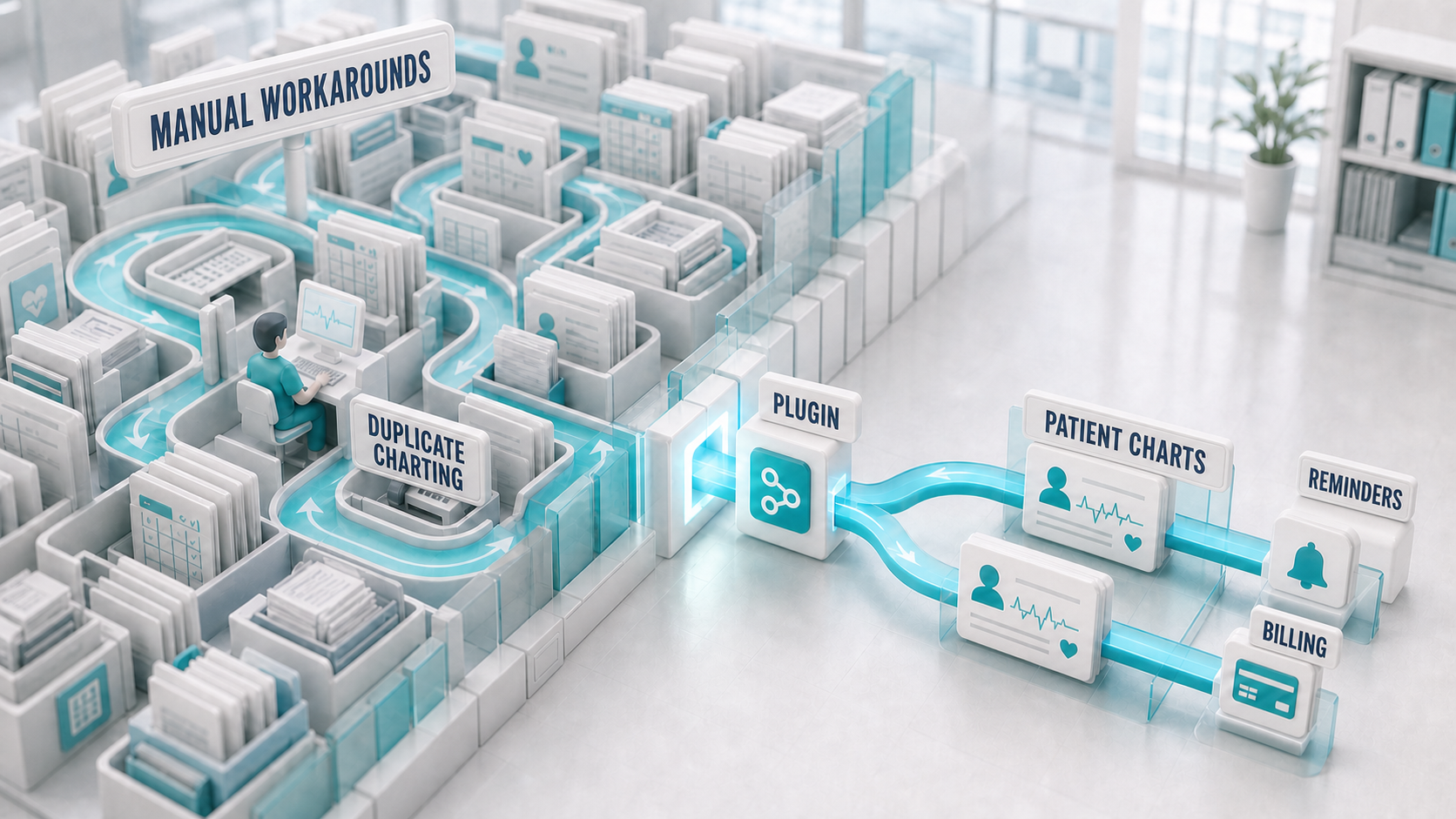
A behavioral health provider finishes a couples therapy session. Then the second half of the job starts.
The same notes, diagnoses, and billing, entered twice. Once in each partner's chart. Then a second appointment booked by hand so both patients get their own reminders.
Every healthcare organization has a workflow like this. Usually several.
And usually nobody sees them anymore. The answer came back years ago and hardened into policy: the EHR can't do that.
That may be the most expensive sentence in healthcare operations. Not because of what it costs to hear. Because of what it does next.
It redesigns your practice around your software's limits. One workaround at a time. Until the workarounds are the workflow and double documentation is just how couples sessions work.
Vicert has been building against a different answer.
We build on Canvas Medical, an EHR designed to be programmable. A real SDK. An extension framework. An open-source community repository on GitHub.
On that foundation we've designed and built 25 production-grade plugins. Seven of them we contributed as public pull requests to Canvas's open-source Medical Software Foundation repository.
For those seven, you don't have to take our word for anything. You can read the code.
That couples session is one of the 25. The provider now documents once.
The plugin writes and signs the documentation on both charts. It records independent diagnoses for each partner, with coding rules enforced as they go. It books the partner's mirrored appointment so both patients get their own reminders, and routes the second patient's billing to the correct queue.
Hours of duplicate charting, gone from every couples visit. Not because a feature request finally survived a vendor's roadmap committee. Because it became a plugin.
Here's what the rest of the catalog does, in the three places clinics feel it most.
Time clinicians get back
Clinical Favorites. A provider keeps the medications and diagnoses they order most and drops one into a note in a single click. Every favorite is checked against the live ontology first. A code that no longer resolves gets flagged instead of written into the chart as a broken order.
Note Templates. An entire visit type, preloaded. Diagnoses, labs, imaging, questionnaires, in the intended order. Applied in one step.
AI Visit Summaries. Two tabs inside the note. One recaps the previous visit. One shows everything that changed since: new labs, medication changes, resolved conditions.
The same plugin produces a plain-language after-visit handout. The clinician edits it before it prints.
Intelligent Chart Search. When a clinician needs something from a dense chart, it answers plain-language questions with source references that link to the exact item. Real-time status, not stale values.
Work that does itself
Documents arriving by fax, upload, or patient portal used to mean a person sorting a queue.
AI Document Intake. It classifies each document, matches it to the right patient, assigns a reviewer, and extracts values like lab results before anyone opens it. Staff review and confirm instead of sort and type.
Automated Medication History. Seven days and one day before each appointment, the chart requests the patient's Surescripts history on its own. Reconciliation is waiting at the start of the visit.
Automated Appointment Notifications. Confirmations and reminders go out by text and email on the clinic's schedule, pinned to a configured timezone. A day-ahead reminder never lands at three in the morning.
Prescription Status Tracking. A prescription that errors or stalls doesn't wait for someone to notice. A rules engine watches e-prescribing status across every patient and creates a follow-up task, routed to the right team, the moment something lingers too long.
The outside world, inside the chart
Dexcom Glucose Viewer. A patient's glucose data in the chart. Trends, time in range. The patient approves access from a link sent through the portal.
Controlled Substance Monitoring. A PDMP check with risk scores, run without leaving the note. Documented automatically as a structured assessment.
Digital Consent Signing. Consent forms signed from the patient portal through DocuSign, with a tamper-evident audit trail written back to the record.
Doxy Telehealth In Chart. A telehealth visit that opens in the chart's side pane. Notes, history, and orders stay one glance away during the call.
Salesforce Patient Sync. Yes, even Salesforce. Patient changes made there flow into a review console where a human approves every write. Deletes are always held for a person.
The lesson travels
The specifics here are Canvas. The lesson isn't.
For years, the gap between "the software almost does what we need" and "the software does exactly what we need" had three closings. A migration. An enterprise feature request. Learned helplessness.
On a programmable system of record, that gap becomes a scoped build. One workflow. One plugin. Weeks rather than quarters.
And when the work is contributed in the open, as seven of ours are, your own engineers can read it before you believe a word of the pitch.
So here's the question we'd put on any leadership agenda. What's the workflow your people have learned to live with because "the system can't do that"?
The double documentation. The queue somebody sorts by hand. The report that lives in a spreadsheet next to the EHR instead of inside it.
If one came to mind while you were reading, we want to hear it.